CT vs. conventional angiography: which is right for you? Explore the key differences, costs, and expert heart treatment options at Jeevandan Health.
CT vs. Conventional Angiography: Which Heart Test is Right for You?
Introduction
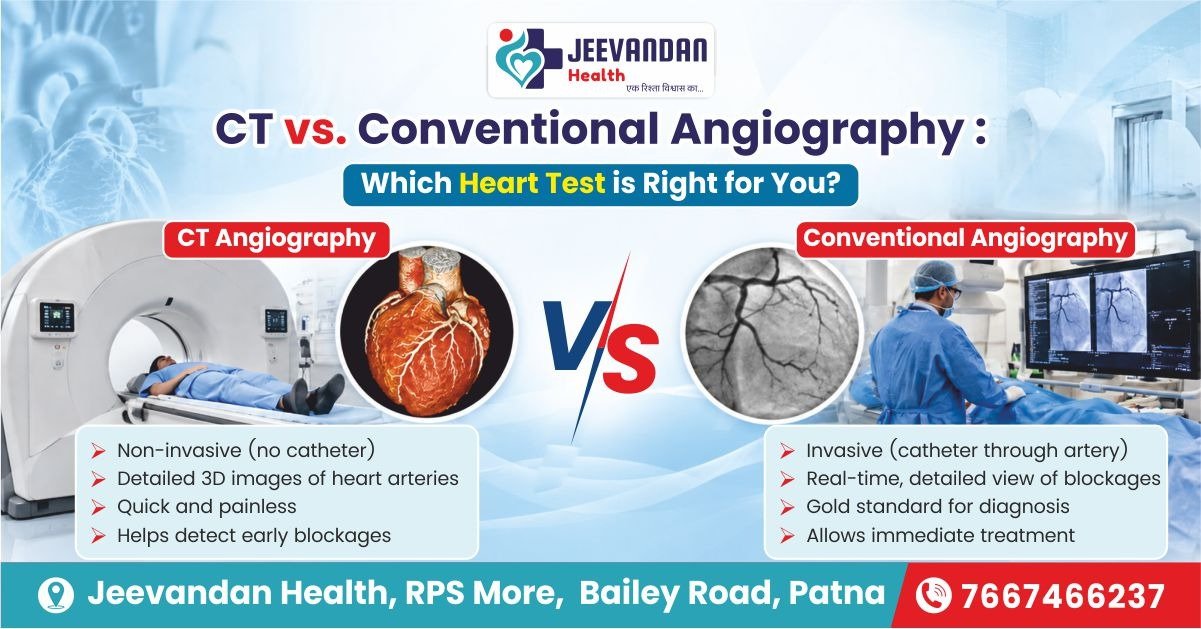
Heart disease is scary, but getting the right diagnosis shouldn't be. If your doctor suspects blocked blood vessels, they might suggest an angiography. Today, you generally have two choices: CT or conventional angiography. Let's break down what each means so you know what to expect.
Think of this as a high-tech photo shoot for your heart. It’s entirely non-invasive. You lie flat on a table, a nurse gives you an IV with contrast dye, and a scanner takes fast, 3D images of your heart arteries to look for plaque buildup.
What Is Conventional (Invasive) Angiography?
This is the traditional, hands-on method. A doctor threads a tiny tube (catheter) through an artery in your wrist or groin all the way up to your heart. They inject dye directly into the heart vessels and take X-rays. If they spot a blockage, they can often fix it right then with a stent.
Key Differences Between CT and Conventional Angiography
The biggest difference is access. CT is an outside-in scan used purely to look. Conventional is an inside job where doctors can both diagnose the problem and treat it during the exact same procedure.
Accuracy and Diagnostic Value of Each Test
Both are incredibly accurate. CT is excellent for quickly ruling out blockages if your risk is low. Conventional angiography, however, remains the gold standard. It gives the clearest picture of exactly how narrow an artery is before surgery.
Risks, Radiation Exposure, and Recovery Compared
CT has almost zero recovery time, though it does expose you to a bit of radiation from the scanner. Conventional angiography carries a very small risk of bleeding or blood vessel damage because a tube goes inside your body. It also requires a few hours of bed rest afterward.
When Doctors Recommend CT Angiography
Cardiologists usually suggest a CT scan if you have unusual chest pain but your overall risk for a major heart attack is low to moderate. It’s a safe way to make sure everything is okay.
When Doctors Recommend Conventional Angiography
You will need this if you are actively having a heart attack, or if a previous stress test strongly indicates you have a severe blockage that needs immediate fixing.
Cost and Procedure Time Comparison
A CT scan is much faster—usually taking just 15 to 20 minutes—and is generally cheaper. Conventional angiography takes 30 to 60 minutes, costs more, and requires a recovery room since it's a minor surgical procedure.
Role of Jeevandan Health in Treating Coronary Heart Disease
When dealing with blocked arteries, timely expert care is everything. If you are looking for reliable heart treatment in patna, Jeevandan Health is a leading heart hospital equipped with emergency cardiac facilities. Their team includes a top heart specialist who can accurately guide you on whether a non-invasive scan or an intervention is necessary for your specific condition.
10 Ways, Habits, and Foods to Keep Your Heart Healthy
Eat more oats: Great for lowering bad cholesterol.
Walk daily: Just 30 minutes of brisk walking makes a huge difference.
Snack on walnuts and almonds: Packed with healthy fats.
Quit smoking: It immediately starts healing your blood vessels.
Manage stress: Try 10 minutes of deep breathing or yoga daily.
Eat fatty fish: Salmon and mackerel are full of Omega-3s.
Cut the salt: Helps keep your blood pressure in check.
Stay hydrated: Drink plenty of water so your heart doesn't work as hard.
Limit processed meats: Skip the sausages and deli meats.
Sleep well: Aim for 7-8 hours to let your heart rest and repair.
Most Frequently asked Questions
a) Does a CT angiogram hurt?
No, you'll only feel a quick pinch from the IV line.
b) Are you awake for a conventional angiogram?
Yes, but you are given medication to help you relax.
c) Which test is safer?
CT is considered safer since it doesn't enter the body.
d) Can a CT scan clear my blockage?
No, it is purely for taking pictures.
e) Do I need to fast before these tests?
Usually, yes, for about 4 to 6 hours beforehand.
f) Is the contrast dye safe?
Yes, but tell your doctor if you have kidney problems.
g) Can I drive home after a CT?
Yes, you can resume normal activities instantly.
h) Can I drive home after a conventional angiogram?
No, you will need someone to drive you.
i) Are there age limits for these tests?
No, doctors decide based on your overall health, not just your age.
j) Will insurance cover this?
Most health insurance plans cover both if ordered by a doctor.
Final Thought
Never take chances with your heart. If you feel tightness or pain, don't wait for it to pass—getting the right test early on can quite literally save your life.
Neither test is "better" than the other; they just serve different purposes. If it's a routine check to rule out issues, CT is fantastic. If your doctor strongly suspects a severe blockage that needs opening, conventional is the way to go.