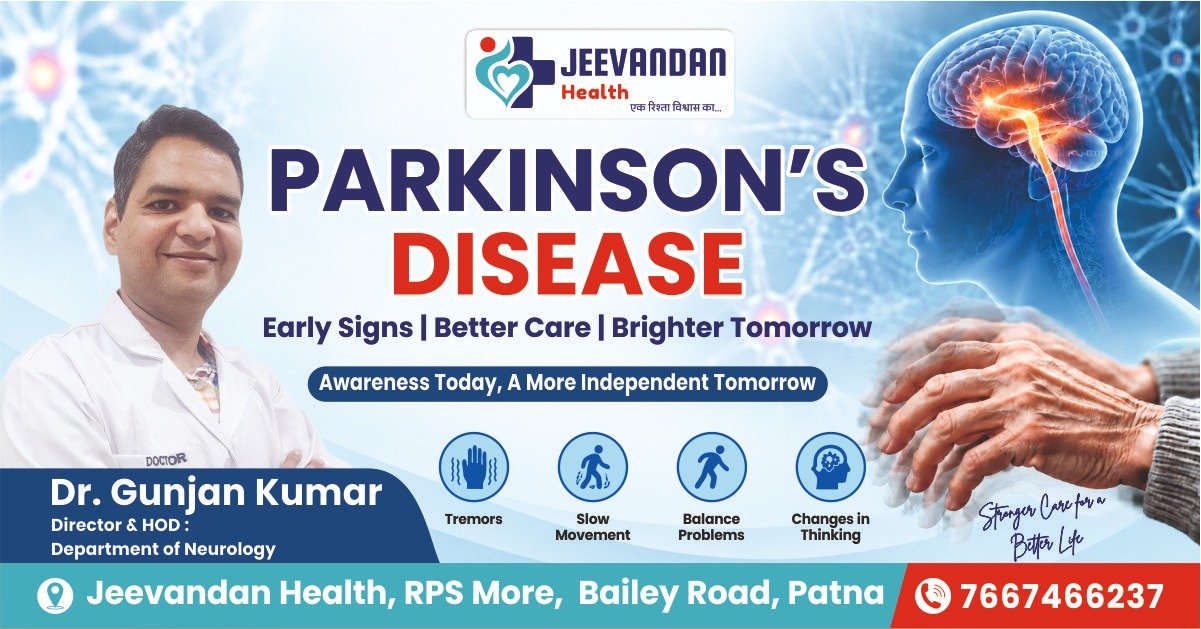
Learn about Parkinson’s disease, including its causes, early symptoms, treatment options, diet and long-term management. Explore Parkinson’s care at Jeevandan Health and understand how timely neurological evaluation can support better quality of life for patients seeking Parkinson's treatment in Patna
Understanding Parkinson’s Disease: Causes, Symptoms, and Treatments
Parkinson’s disease is a progressive neurological condition that mainly affects movement, but it can also influence sleep, mood, digestion, memory and everyday activities. It is linked to the loss of dopamine-producing nerve cells in a part of the brain called the substantia nigra. While there is currently no cure, timely diagnosis and a personalised treatment plan can help many people manage symptoms and maintain independence.
How Common Is Parkinson’s Disease in India?
India has a significant Parkinson’s disease burden. A 2025 review of community-based Indian studies estimated that around 5.76 lakh people (0.576 million) were living with Parkinson’s disease, while also noting that India still lacks enough large-scale population studies to establish an exact national figure.
📊 Parkinson’s Disease in India — Estimated Burden
Estimated people affected India ████████████████████████████ 5.76 Lakh Worldwide ██████████████████████████████████████████████████ 117.7 Lakh*
*Global figure: estimated prevalent cases in 2021 from the Global Burden of Disease study. India was among the three countries with the highest number of cases. Causes and Risk Factors
The exact cause of Parkinson’s disease is not completely understood. Age is an important risk factor, while genetics and certain environmental exposures may also contribute. A person can develop Parkinson’s without having a family history of the condition.
Common Symptoms of Parkinson’s Disease
Symptoms can develop gradually and differ from person to person. Common signs include:
Tremor, particularly when the hand is at rest
Slowness of movement (bradykinesia)
Muscle stiffness
Balance and walking difficulties
Changes in handwriting or facial expression
Reduced sense of smell
Constipation and sleep problems
Changes in mood or thinking
A persistent tremor or unexplained slowing of movement should not simply be attributed to ageing. A neurological evaluation can help identify the cause.
Parkinson’s Disease Treatment
There is no single treatment that works for everyone. Depending on symptoms and disease stage, treatment may include medicines such as levodopa/carbidopa and other Parkinson’s medications, along with physiotherapy, occupational therapy, speech therapy and lifestyle support. In selected patients with significant movement complications, advanced treatments such as deep brain stimulation may also be considered.
The goal is not simply to prescribe medicine but to create a treatment plan that fits the person's symptoms, daily routine and changing needs.
How Jeevandan Health Supports Parkinson’s Care in Patna
At Jeevandan Health, the Neurology Department provides diagnosis and management of movement disorders, including Parkinson’s disease. Its neurology services include neurological assessment and diagnostic facilities such as EEG, Video EEG, NCV, EMG and SSEP. The hospital also lists movement-disorder care and rehabilitation support among its neurological services. (Jeevandan Health Hospital Patna)
Dr. Gunjan Kumar, Director and HOD of Neurology at Jeevandan Health, lists Parkinson’s disease, tremor and other movement disorders among his clinical areas of expertise. (Jeevandan Health Hospital Patna)
For someone looking for Parkinson's treatment in Patna, having access to neurological evaluation, follow-up and rehabilitation services can be an important part of long-term care.
Can Diet Keep Parkinson’s Disease Away?
There is no specific food or diet proven to prevent Parkinson’s disease. However, a healthy eating pattern supports overall brain, heart, bone and digestive health. The Parkinson’s Foundation recommends a balanced diet containing vegetables, fruits, whole grains, fibre, nuts, healthy fats and appropriate protein, along with adequate hydration. (Parkinson's Foundation)
Good choices include:
Green leafy vegetables and colourful fruits
Whole grains and pulses
Nuts and seeds
Fish and other healthy protein sources
Adequate water and fibre
Less processed food, excess sugar and saturated fat
People taking levodopa should discuss meal timing and protein intake with their doctor, because protein-rich meals can affect medication absorption in some patients. (Parkinson's Foundation)
10 Frequently Asked Questions About Parkinson’s Disease
1. What is Parkinson’s disease?
It is a progressive neurological disorder that primarily affects movement.
2. What are the first signs of Parkinson’s?
Tremor, stiffness, slower movements and changes in walking or handwriting are common early signs.
3. Can Parkinson’s disease be cured?
There is currently no cure, but treatment can help control symptoms and improve quality of life.
4. Is Parkinson’s disease hereditary?
Most cases are not directly inherited, although genetic factors can contribute in some people.
5. Can young people develop Parkinson’s disease?
Yes. Young-onset Parkinson’s can occur, although it is less common.
6. Is every hand tremor Parkinson’s disease?
No. Tremors can have several causes, so proper neurological evaluation is important.
7. What medicines are used for Parkinson’s?
Levodopa-based medicines and other drugs may be prescribed depending on individual symptoms.
8. Does exercise help Parkinson’s disease?
Exercise and rehabilitation can support mobility, strength, balance and overall wellbeing.
9. What foods are good for Parkinson’s disease?
A varied diet rich in vegetables, fruits, whole grains, fibre, nuts and healthy fats is generally recommended.
10. Where can I seek Parkinson’s treatment in Patna?
A neurologist can assess symptoms and develop an appropriate treatment plan. Jeevandan Health provides neurology and movement-disorder services in Patna. (Jeevandan Health Hospital Patna)
Conclusion
Parkinson’s disease can change the way a person moves and lives, but it does not mean that every part of life has to stop. Early assessment, appropriate medication, exercise, rehabilitation, nutrition and regular follow-up can make a meaningful difference. For patients searching for the best hospital for Parkinson treatment in Patna, the important factors to consider include experienced neurological care, appropriate diagnostics, multidisciplinary support and long-term follow-up—not just a hospital name.